

Leyneuf Tines
First and foremost, thank you to the coast because without the coast, how do we move from here to there?—Gboyega Odubanjo, Adam1
What comes next cannot without a story of water and offering. The sun shines and we gather because the river allows it. Na from clap dem dey enter dance.—Gboyega Odubanjo, Adam2
Offering a practice to animate assembly, rasanblaj circulates in a manner that gathers and regroups, an invitation to engage with the multiplicity and complexity of the Caribbean in a radical, erotic and decolonial historical present and future. A way of convening the scatterings of colonialism, denied histories, slavery and migration—bodies, memories, languages and worlds, rasanblaj is not just metaphor but a movement. It attunes as a choreography of survival: the drum circle, the protest march, the congregation around an altar, the diaspora returning home through sound.
Water is rasanblaj’s teacher, it gathers tributaries into rivers, rivers into oceans. It carries fragments across distances, connecting islands, ports and shores, always dealing with change, moving consciously into the flow of lives. It remembers what has been thrown into it: offerings, bodies, prayers, oracles.
Rasanblaj reminds of Audre Lorde’s questions: Who are you? Why did you come? Are you doing the work you came here to do? And rasanblaj adds the pivotal fourth question: Who walks with you? Here we are reminded of Nigerian-American dancer and choreographer Okwui Okpokwasili’s practice and collaborative project, Sitting on a Man’s Head. A key artist in the New York experimental dance scene, Okpokwasili’s research into Southeastern Nigerian women’s embodied protest described as the Woman’s Egwu of 1929, or Women’s War, resulted in the durational performance. She adopted tactics from the disruptive durational practice in a form of protest traditionally practiced by women in eastern Nigeria, metaphorically called “sitting on a man’s head,” in which a collective invasion of seats of power was a strategy to speak back, air grievances and effect change. Okpokwasili reimagines the collective movement in an embodied space through gestural expressions and improvisational vocalizations that act as a mode of communing, constructing spiritual and physical room to transform collective protest into song activated by all that enter the space. The artist opens a space for her concern of restoration and restitution, “making a space for the formation of new bonds of kinship.”3
Okpokwasili’s work adds to Lorde’s questions and asks us, “What do you carry that also carries you?”4 In a spirit of rasanblaj, konesans is the companion, a deep listening, the somatic attunement known in Vodou circles as a spirited knowledge on how to heal and refers to “open channels of communication who provide their healer with information about what is going on at the deepest levels of persons, or even about what will happen to them in the future.”5
In response to Rasanblaj’s invitation to an ongoing meditation on animate assembling, recuperating from its cosmological imagination and diverse formations, the Haitian diasporic director, hypnotist and sonic artist Michaelange Quay navigates waters as a transit, a birth canal that engages with technologies of memory, motions and archives to feedback information for an ancestral therapeutic continuum in his project Electrovaudou. It sets off an activation of past and future.
Somatics of the Diasporic Ensemblic: The Feedback of Electric Ancestors Yet Unborn
the roots and branches of a blues news day, this particular prophet’s tree intertwined umbilical vines and extension cords now whispering, now demanding overtime, with backpay, loan forgiveness, grand jury held hostage by a gift mule’s grimace of rage. It will come in perfect waves, at sundown, octaves as octets, the feedback of electric ancestors yet unborn, electric shipmates laying in her cut, awaiting revolutions backwashed, rewriting outrage déjà vu—we will kill again, we will be killed no more, not this time, and never the same way once—no death after life, no myth of regret in this unconditional remember. Peerless mirror, say something. I am ever on the virgin, my conception is immaculate.
Michelange Quay, Electrovaudou6
Quay’s epigraph Electrovaudou refers to the multiple motivations to reconnect the ancestors in and through their ceremonial healing process with a redress of history. In the same instance, he indicates the presence of the postindustrial cultures of technology, “electric ancestors yet unborn,” “electric shipmates […] rewriting outrage,” and their concomitant decolonial artistic speculative potential. The artist invites us to acknowledge the “unborn” who inhabit a place (the waters, the transit, the Middle Passage), a time (not now, a predicament of the future, a déjà vu) and a condition (not yet, haunted by a revolution, rewriting the past). The prophet’s tree murmurs, bound to a struggle for freedom demanding justice for overworked time, for loan forgiveness from those who enforced it into a value system set forth by its self-claiming as a sovereign state in the global order (the liberated nation state), for paying back the right to be human or, rather, troubling the human’s proper ontological grounding, or a claim to those who owe an (unpayable) debt to Black reproduction as the birth of modernity’s existence, an insurgent reproduction threatening to overspill Black revolution to neighboring islands. The waves and waters will bring it, wash it ashore, undulate when the light is low and the concord for a tuning of fork and pitch, all the notes of a scale will resound to redress the Haitian Revolution, Haiti’s prophet is on the verge, awaiting the after-effects of the revolution, inimitable reflections of an anoriginal sin at the birth of Hayti. Could Quay be referring to what sociologist Mimi Sheller has called the “Haytian fear”—“code for an unruly and barbaric Blackness that threatened to export Black revolution to neighboring islands and disrupt colonial power”?7 Quay’s Electrovaudou reconceives a persistent fugitivity, in earthly matter (trees, branches, roots, waves, vines), sonic elements (chords, octaves, octets), value (back pay, loan forgiveness) and temporality (life, death, conception, overtime, it will come), to remind us of the haunting of Vodou’s presence in distinct discourses on universalism, concerning the self-grounding of modernity and the positing of subjectivity that identifies the “European” subject with the ground of this imperium. Quay re-inscribes the displaced invocation of a repressed “non-Europe” in the spatial imperium of the Western enterprise in the delineation of modernity. He forces us to consider what it takes to reconstitute a human subject on fractured grounds, by asking us to consider the constitutive nature of prior exclusions.
Michelange Quay works through differing temporalities of Afrodiasporic personhood manifested in his sound project Electrovaudou. Sonically, Quay’s projects are composed of a captivating cross-talk of Vodou rhythms, uncompromising Chicago foot work tropes, dark synthesizer melodies and relentless, electrifying energy. His research and personal relationship to the Vodou cosmology drive his work, spanning from cinema to electronic projects to call into question the legacies of the transatlantic slave trade. By way of sonic immersion, he relays to the listener a necessitated deep engagement in activating and restructuring the hierarchy of the senses to create new forms of experience and reveal what is in between or at the margins of our perception to articulate experiences of spirited states of being. The alternative forms of knowledge production and their concurrent temporalities that are borne from such an immersion with the spirits—which have been dismissed as irrational by rational mechanisms of homogenized knowing—extend the animate assembly outward into a cosmos of sound.
Expanding on spirit technologies, Quay’s project interacts with Black scholar Alexander Weheliye’s thinking through electromediatization. In his focus on the past through its tactical recovery of Black soul, Weheliye offers us electromediatization as an amplification of channels of communication among the cultures of the Afrodiaspora that channels and remixes the spirits of modernity.8Electrovaudou’s electromediatization in Haitian diasporic manifestation becomes the dialogue between these forms as technologies of the spirit and time travel—divination foregoes linear time and gestures towards an envisioning of the future with a cyclical influence. By reproducing rhythms to interpret the archive, Quay sonically explores audiovisual modes of hypnotic potentials in an aesthetic and sonic condensation of a “return” to Vodou to animate and perform a divination of rasanblaj futures.
Approaching beats per minute used in Chicago foot work layered—then enmeshed with Vodou rhythms as a tool to narrate Caribbean futures sets the stage for the conditions of remapping a shift in speculative Caribbean thought. As a dance, foot work is a blindingly fast-paced movement of the feet in which dancers string together combinations of twists and turns with seamless transitions. Like krumping, or jit, foot workers use the combinations to battle each other, competing in the middle of a circle of dancers and audience. Footwork developed out of a similar style of dance music called juke in the mid-1990s. Juke music has an extremely fast tempo, around 160 beats per minute, but it features bass kicks, claps, high hats and sample in very short increments. In foot work, beats per minute are the same but the bass drum is used more sparingly. Also absent is much of the percussion and vocals that clutter juke’s beats, leaving behind a half tempo that allows dancers more room to express themselves. The tracks—repetitive and hypnotic—often have a grungy, lo-fi aesthetic. According to many foot work DJs, who began their careers as dancers, dancing still drives the direction of the music and, as a result, if a produced track has a relatively weak reaction from the audience, it will have a similarly short life span. The dance applies the evolutionary pressure, says Nate Boylan,9 producer, and, as such, drives the innovation in the music.
A collage of time occurs in the accumulation of beats per minute; postindustrial Chicago foot work immerses us in an overlap of histories. Electrovaudou engages Vodou rhythms through a Haitian diasporic lens from which to meditate on Vodou temporalities and “ancestral futurism.” Thinking with Black quantum futurism to articulate a “new language of healing, memory, and justice that can be transmitted and used as a technology,” the project reassembles countermemories to contest the colonial archive and open the feedback loop of time.10 The loss and gain encompassed in Quay’s project and beyond it in his hypnotic practice is at once a crystallization both of a suspension and transcendence of temporality—it allows diasporic identity to fluidly fluctuate between moments in history and the present that decisively reformulate moments of the future that have consistently been relegated as unimaginable. The unimaginability is in fact the refusal of modernity to work through slavery and diaspora, to deal with its own project of recovery that has been formative in the creation of its own and others’ subjectivities. The damning of Vodou rhythms, the ghettoization in the process of becoming of an Afrodiasporic subjectivity and repression thereof in the Western imaginary moves from space to rhythm, moves from plantation to the Chicago basement, from the plantation to the outskirts of industrialized culture that is insistent on retaining spirit. We are transported to moments in history, and such a suspension functions as a refusal of enclosure. A protest. Electrovaudou offers an accelerated forecast of dimensionality into postindustrial Black modalities distinct with frequencies of Haiti’s spiritedness.
His discovery of the practice was part of his return to Haiti. Influenced by electronic music, in particular Chicago foot work, Quay took the inspiring and transcendent Vodou rhythms to formulate a visceral connection between the industrial and spiritual world of rhythms. The project, Electrovaudou, that emerged out of such an inspiration became an immersive listening experience into a spiritual and sonic initiation into “going back.” The hypnotist and self-described “intradimensional citizen” works through regulatory mechanisms of cultural memory by blending different rhythmic genres of the 20th and 21st centuries while additionally revealing the longing for a trance-ient, transcient state through a return to Haitian Vodou that contests the dynamics of cultural memory in legal or state recognition. The “intradimensional” subjectivity born of this longing provides pathways to bypass legal-racial methodologies. By establishing a non-consensual narrative of modernity, it transcends humanistic forms—serving not only as a move beyond Blackness and corporeality but as a radical ontological transformation. Reproducing rhythms to interpret the archive presents us with an ontological processing of the dilemma on how one ought to archive slavery’s archive and formulate diasporic identity.
Intradimensional practices and tactics are at play in the sonic project to express the excess of temporal movements of yearning in the activation of Haitian futures. By intradimensional I refer to what could constitute otherwise “unthought” Caribbean futures, the intersections and the intradiasporic differences by way of Haiti. It is in the intrarelation of affectivity and spirit forces where my insertion of “unthought” rasanblaj futures comes to fruition. Scholar Mimi Sheller writes of what she calls the “storiation” of island life, routed through islanders’11 own belief systems and practices found in the multitude of affective expression in bodies, embodied and embedded in the aftermath of colonialism. Practices such as dance, music and entrancement are offerings of an embodied response to the deliberation on rasanblaj, who walks with you, wherein both language and corporeality reveal the performative and political project. The waterways chart the (re-)storiative speculative possibilities when routed through islanders’ own belief systems and practices. Barbadian academic, poet and widely recognized literary canon Kamau Braithwaite’s “psychic marronage” is invoked, in which Haiti’s intrarelational symbolic and cultural practices are maintained in the national body politic. The corporeal history occurs at the intersections of the anafoundational rupture of the slave trade, of the future anterior, the “will have come”: the bodies in excess of the national body politic, uncontainable and unstable in their extralegal lawfulness and serving to further constitute a global space of Haiti’s presence. The metaphor of water central to rasanblaj, as charting certain pathways and moving consciously into the flow of a liquidity, is performed and furthered into a futurity for Vodou.
Bodily Haptic Realities: Tuning the Instruments of Perception
In a substantiation of multiple times, a merging of diasporic homecomings that engage Haitian Vodou rhythms and postindustrial Chicago foot work sonics, a demarcation occurs, a crossroads in order to receive—a transition from diaspora to home, from human to sacred environments. If these syncretic elements anticipate a spiritual homecoming and personal background of the birth of the project, Electrovaudou is part of a new generation of Caribbean artists making experimentations that entertain the possible interactions between humans and spirits, a rasanblaj of rhythms, memories and machines. It stages an oracular memory, sound that divines, carries and calls forth. The inherent power is intimately connected with a spiritual world of syncretic Vodou beliefs and practices and vitiates the existence of antiquity rooted in modernity’s record of cultural memory. A re-memory.
Similar to the dance form, Quay relays to the listener a necessitated deep engagement in restructuring the hierarchy of the senses by way of sonic immersion to create new forms of experience. The level of engagement reveals what is in between or at the margins of our perception to articulate experiences of spirited states of being. This activation brings to mind Jamaican-diasporic dancer Serafine1369, who offers a somatic reflection on rasanblaj. They assume their labor as choreographer to be transmitting an embodied synthesis of somatic methods and practices of listening to allow the surfacing of embodied knowledges in others, extending invitations into dancing emergent relational choreographies. As a choreography of rasanblaj, it extends the gatherings and regroupings into a somatic attunement with intrarelational Caribbean futures.
From this perspective, the senses produce after-affects in a crystallization of the past, not in an institutionalized discourse but turned toward the future whose screens would be populated with all kinds of decolonizations of the psychic state of feeling. The psyche-acoustics explore how the body and memory are affected by sounds and rhythms, folding temporalities into one another and creating connectivities across time, space and dimensions. The enormous amounts of data and the superimposition of different frequencies and waves transmitted by the sounds create the web of energetic fields that connect multiple materialities of both animated and inanimate beings.
Providing us with a sounding board for several crucial questions with respect to constructions of Haitian personhood as composed via sound, technology, spirituality and temporality, Electrovaudou lends itself as a compositional vehicle in the intensities that are constituted by invocating Vodou spirits, Vodou technologies and thus an event in time. It does not explain; it gathers. It instructs by vibration, divines by repetition. This re-memory makes space for speculative Caribbean rasanblaj futures on the wider stage that tend to monopolize global Blackness by a North-Americanicity and Anglo-centrism. Addressing recurring move backs against modernist logics of time both in the body and in history, in the spaces in which the body can be borne anew outside of the modernist logic imposed on what a body can do, a subterranean poetic effort enters the present with intradimensional elements of futurities in the body. In this material labor of producing the techne, the Haitian diasporic psyche evokes multiple points of connectedness within the wider Afro-Americas and Africa, suggesting a ellipse of time in the body to spark forth an entrance to intradimensions.
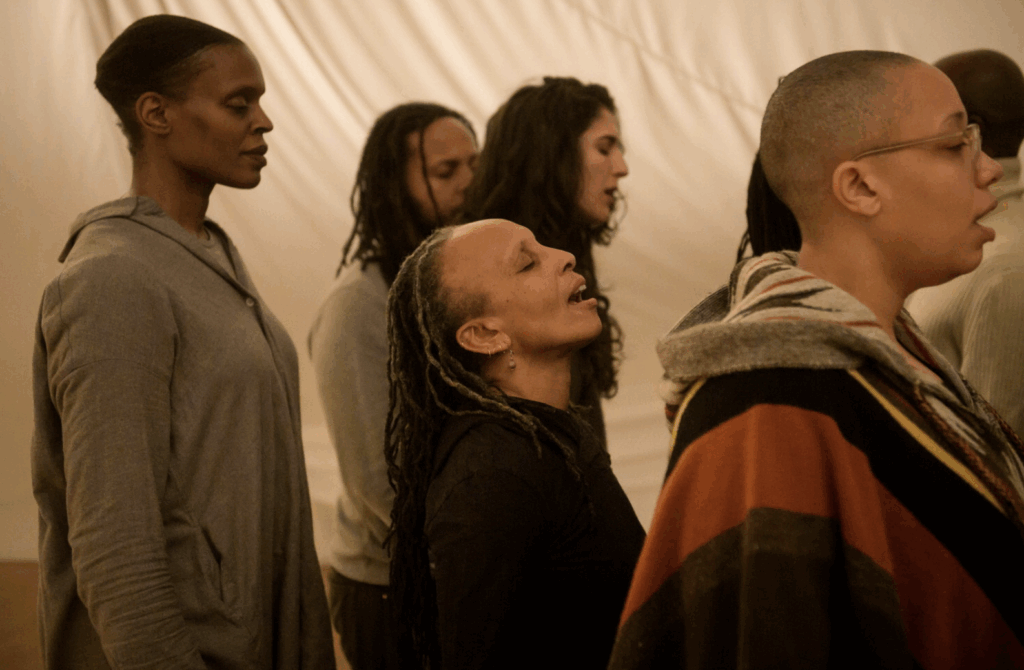
Image 1
Okwui Okpokwasili, Charmaine Warren and jess pretty in Sitting on a Man’s Head, performed at Danspace Project on Friday, February 28, 2020 as part of Platform 2020: Utterances from the Chorus, co-curated by Okwui Okpokwasili and Judy Hussie-Taylor. Photo by Ian Douglas
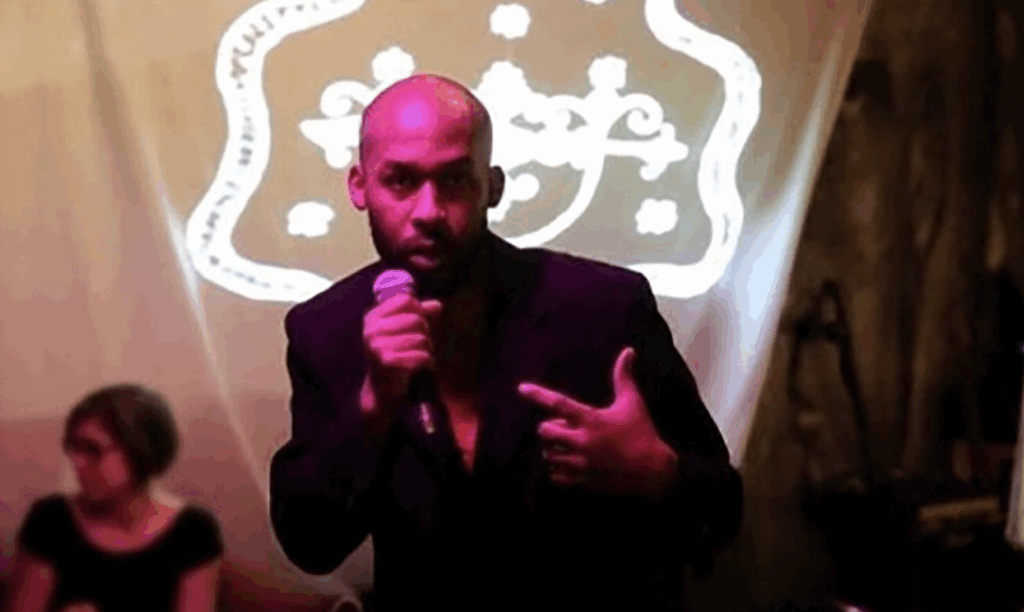
Image 2.
Michelange Quay performing at La Nuit de morts-vivants. Performance of Jean-Ambroise Vesac and Michelange Quay at the Musée d’art de Rouyn-Noranda, October 31, 2020.
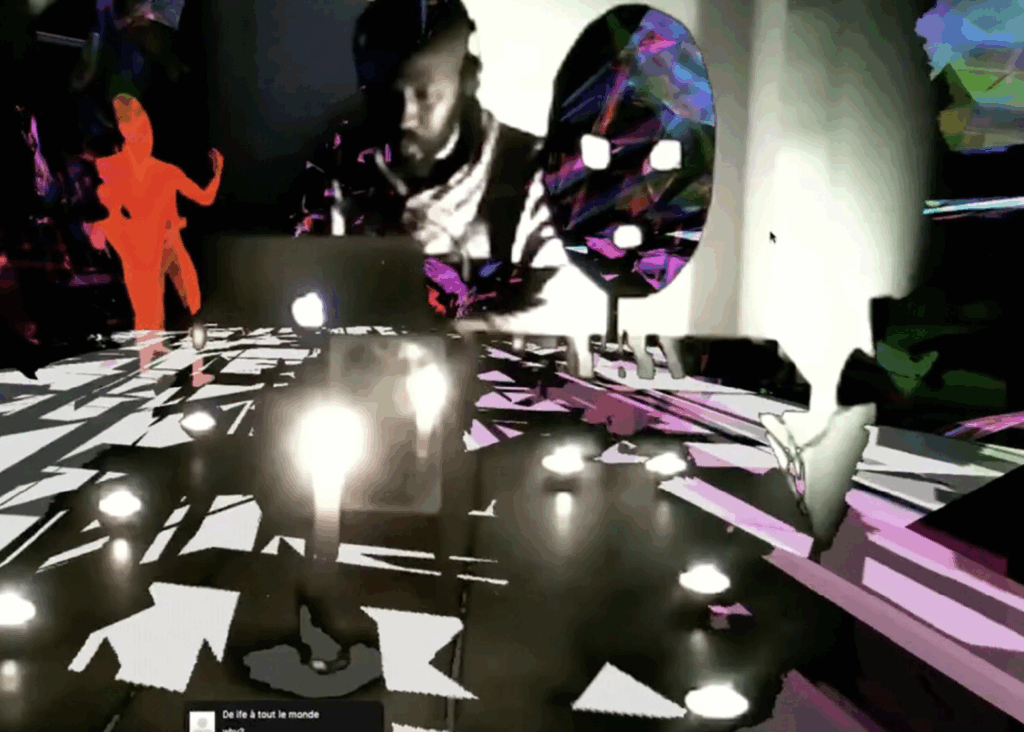
Image 3.
Excerpt from La Nuit de morts-vivants. Performance of Jean-Ambroise Vesac and Michelange Quay at the Musée d’art de Rouyn-Noranda, October 31, 2020. Image from Musée d’art de Rouyn-Noranda.
Seeking to unfold the geologic dimensions within the complex matrixes of colonial life where life enacts sensibilities of matter, time, intimacy, institutions and waterways, the assemblages of Electrovaudou reveal something essential to the work: that base forms do not give less than the excess that obscures them. Through listening and dance, bodies animate assembly to speak, and both arrange and emphasize the tension between spirited information, colonial histories at the shores of rasanblaj possibilities through the proximity of different bodies. The oracular practice serves as an opening of thresholds that itself helps us listen to that which exceeds sense.
Notes
- Gboyega Odubanjo, Adam (London: Faber & Faber, 2024), 5.
- Odubanjo, Adam, xiii.
- This excerpted text, written by Okwui Okpokwasili and Peter Born, was first published, in full, in the Platform 2020 Catalogue, Utterances from the Chorus, Vol. I. https://danspaceproject.org/2020/04/14/sitting-on-a-mans-head/.
- Kristin Juarez,. “Within the Whirlwind of the Encounter: An Interview with Okwui Okpokwasili,” Liquid Blackness 5, no. 1 (2021): 104.
- Karen McCarthy Brown, “Altars Happen,” African Arts 29, no. 2 (Spring 1996): 67.
- Michelange Quay, “Electrovaudou,” 2015. https://electrovaudou.wordpress.com.
- Mimi Sheller, Democracy After Slavery: Black Publics and Peasant Radicalism in Haiti and Jamaica (London: Macmillan Caribbean, 2000).
- Alexander Weheliye, “‘I Am I Be’: The Subject of Sonic Afro-Modernity,” Boundary 2 30, no. 2 (2003): 109.
- Nate Boylan, known professionally as Boylan, is a Chicago-based producer and member of the influential Teklife crew. He is a significant figure in the footwork scene, known for bridging the genre’s underground roots with his career as a public school educator.
- Anaïs Duplan, “Moor Mother Explains Black Quantum Futurism,” 2017. https://www.vice.com/en/article/moor-mother-explains-black-quantum-futurism/.
- Mimi Sheller, Island Futures: Caribbean Survival in the Anthropocene (Durham and London: Duke University Press, 2020): 146.
Notes on contributor
Leyneuf Tines is an independent researcher currently based in London who develops ongoing experimental and collaborative research practice on the body in performance across post/colonial time-spaces, cultural formations and emerging cosmic alternatives.
Notes
Contact Leyneuf Tines leyneuf.tines@gmail.com
© 2026 Taylor & Francis Group, LLC