Poisoned Water, Racism and the Specter of Neoliberal Fascism
“Flint still doesn’t have clean water.”[1]
Michelle Wolf, White House Correspondents Dinner, April 28, 2018
“Neoliberal fascism, as a form of extreme capitalism, views democracy as the enemy.”[2]
Henry Giroux, June 2018
Certanya Johnson sat crying before the Al Jazeera reporter in May 2018. The Flint native was threatened with a water shutoff at any time for her inability to pay an overdue bill of $6,916 for Flint tap water. It was liquid she had not tasted for four years, ever since Michigan state officials poisoned it. Johnson has suffered five strokes since 2015, and her only income is an $800 monthly Social Security check.[3]
“What are you going to do?” Dena Takruri, the AJ reporter, asked her.[4]
“I don’t know.”
The Flint water crisis began when Governor Rick Snyder appointed an Emergency Manager — a kind of czar or dicta empowered to take control of the city, overruling Flint’s mayor and city council. The appointee, Darnell Earley, decided to switch the city’s water source from the relatively clean Lake Huron to the corrosive Flint River in 2014. The ostensible goal: to save $5-million.
Johnson witnessed a catastrophe unfold in her hometown: 8,000 children exposed to lead, a potent neurotoxin; at least 12 deaths from Legionnaire’s disease; an estimated 200 or more miscarriages and fetal deaths from exposure to lead-poisoned water; housing values falling precipitously; government cover-ups, lies, false reassurances, protests and widespread suffering.[5] Over that time, Johnson survived on bottled water, mostly supplied by the state government.[6] On April 6, 2018, Governor Snyder announced that he was ending the free bottled water because, he said, the official lead levels had dropped to less than 15 parts per billion, the Environmental Protection Agency’s drinking water standard. That bottled water had been Johnson’s only source of clean water.
It was in this context that comedienne Michelle Wolf courageously stared down the Trump administration and spoke truth to power, screaming, “Flint still does not have clean water,” at the White House Correspondent’s dinner.[7] She was right. In fact, the water issue is just the tip of the proverbial iceberg.
Unspoken by Wolf that day is a terrible irony. Just miles from Flint, not far from Lake Michigan, Nestlé Corporation is plundering Great Lakes water for a nominal $200 annual state fee. Nestlé is making millions in profits by commoditizing the public’s water. On April 2, 2018, just a few days before Wolf spoke out, the Snyder administration approved a permit allowing Nestlé to pump more freshwater (576,000 gallons each day from one of its wells), even though some 80,945 people opposed it in a public comment period and only 75 approved.[8]
Michigan’s Department of Environmental Quality (MDEQ) said that those comments do not matter.[9] In other words, democracy does not matter. The Michigan Citizens for Water Conservation (MCWC) is contesting
Figure 1. Picture of Nestlé’s Bottle. Photo by Brian McKenna
the decision, along with the Grand Traverse Band of Ottawa and Chippewa Indians, arguing that a “public comment” requirement was not properly considered. Jim Olson, the President of FLOW (For the Love of Water) is litigating the case. He is arguing that “by interpreting or relaxing the law [MDEQ] … help[ed] Nestlé get the permit.”[10] The case sits before Daniel Putter, MDEQ administrative law judge, awaiting litigation.
In 2016, the wife of Governor Snyder’s former chief advisor, Dennis Muchmore, had a very influential job working for Nestlé. Deborah Muchmore had long served as Nestlé’s chief spokesperson for Michigan, and by early 2016 was still serving as a Nestlé consultant for Mecosta County.11 One feature of Nestlé’s PR marketing strategy seems to be playing down or disguising the origins of the water. The name on that Nestlé’s water bottle? Ice Mountain. It is not “Lake Michigan Water.” Incidentally, there are no ice mountains in Michigan.[12]
Will Bunch of the Philadelphia Inquirer helped put Wolf’s comment into wider perspective. “There is a five-alarm fire and the majority of Americans are counting on a free and unfettered press to stop the accelerating death of our democracy before this goes any further,” he said. “That means breaking some old rules and inventing some new ones, in the name of publishing the truth. I don’t have all those answers but I do know this: This republic won’t survive unless people start getting as uncivil as hell. Just like Michelle Wolf did.”[13] Governor Snyder wants citizens and the national media to say that the Flint crisis is over. He told Flint Mayor Karen Weaver as much. Weaver pleaded with him on April 16, 2018, to keep distributing the free bottled water. As she relayed the story, he responded “no” and told her “to get over it.”[14]
Nearly 12,000 homes still have corrosive lead pipes, and the repair work to replace them will take years. Tens of thousands fear drinking any water that comes from the taps; they do not trust the filters or the government. They still pay among the highest water rates in the country. And now they must pay
for the bottled water, which for some is half their income. To date, fifteen government officials have been charged, some with manslaughter, [15] but the Governor, incredibly, has not been legally implicated.
The Battle Over History; Three Narratives
“Memory is the enemy of totalitarianism.”
Albert Camus [16]
With the election of Donald Trump, the political tide turned dramatically to the right. Trump’s ascendance exposed “a plague of deep-seated civic illiteracy, a corrupt political system and a contempt for reason that has been decades in the making”. [17] In an Orwellian world, investigating “the truth” takes time. However, truth-sleuthing is a fundamental plank in the struggle against an extreme form of capitalism in which populations are rendered disposable to a national security state that views democracy as an enemy. Flint was once a mighty union town, the birthplace of General Motors and the United Auto Workers, but now the community is viewed as a national sacrifice zone.
Several overlapping perspectives on the Flint story help expose darker realities with national implications. I will discuss three here: the whistleblower hero narrative, the environmental racism narrative and the neoliberal fascism narrative.
The Whistleblower Hero
An Opening Narrative
According to this story, the significance of the Flint events rests on the activism of four “whistleblowers.” One is Leanne Walters, a mother of four who in 2015 began investigating the city’s tap water and contacted an EPA water expert, Miguel Del Toral. She obtained a list of the chemical ingredients the Flint water treatment plant was using and sent them to Del Toral, who was based in Chicago. He was shocked to discover that Flint had no corrosion control chemicals to prevent lead from leaching from household water pipes and into the drinking water. Phosphate chemicals used to clean the water would have cost about $100 a day. He wrote a report and quickly notified Michigan Department of Environmental Quality officials. They ignored him and Del Toral got into trouble with his superiors at EPA, even though he was just doing his job. [18]
Del Toral contacted his colleague at the University of Virginia, Dr. Mark Edwards. Edwards was a civil engineer and drinking water specialist who had unearthed Washington, D.C.’s, lead water crisis some 15 years earlier. A McArthur genius award winner, Edwards immediately gathered carloads of his students, promised them pizza, and drove 600 miles through the night to Flint.
Together, with the help of citizens, they collected tap water from thousands of homes and had it tested. In September 2015, at a news conference in front of Flint’s city hall, he announced that the lead levels from hundreds of Flint homes exceeded the safety standard of 15 parts per billion. In one sample, the lead was so high it could be considered hazardous waste. [19] Michigan officials tried to discredit him, calling Edwards a “rabble rouser.” One MDEQ official charged that Edwards was “offering broad dire public health advice based on some quick testing [that] could be seen as fanning the political flames of irresponsibility.” [20]
Dr. Mona Hanna-Attisha, Director of Hurley Hospital’s Pediatric Residency Program in Flint, was influenced by Edwards’ findings and contacted him. She decided to do research on the effects of lead on her patients, comparing pre-2014 levels with the 2015 findings. Liberating this information, which had been filed away, she was shocked to see that lead levels had risen over 200 percent in children’s blood in her study. She and her staff put together a report raising the alarm. Hanna-Attisha was concerned about what this kind of independent action would mean for her future career, however. When she presented her data publicly she was initially dismissed by the Snyder administration, who called her research “unfortunate” and said she was responsible for creating “near hysteria.” [21] By this time, Flint residents had been drinking the toxic water for more than a year.
Eventually, Michigan state government began to take seriously the research findings of Attisha and Edwards, marking a pivotal phase in the scandal. Michigan government finally publicly admitted that there was a horrific problem. The two doctors were vindicated. The Flint River water source was
switched back to the cleaner, Lake Huron– sourced plant in Detroit. Yet the state’s forced recognition of a catastrophe was just the beginning, and the full details of its culpability for death, injury and trauma were still to be uncovered. Tens of thousands of household services pipes are still leaching lead, and new problems continue to be revealed. Indeed, a lawsuit against Genesee County, on behalf of more than 91 prisoners, “alleges that prisoners were forced to drink tap water even after officials knew about the lead contamination.” [22]
“It only takes one”
On May 13, 2016, Hannah-Attisha and Edwards danced out to the commencement speakers at Virginia Polytechnic Institute and State University (Virginia Tech) doing “The Hokie,” the school’s official dance where students and faculty excitedly jump up and down. They were commemorated for solving
the Flint water crisis. “When I saw all of you doing the Hokie,” said Hannah-Attisha, “if only one person had stood up and jumped how lonely and uncomfortable and strange that would have looked. People might even have told them to sit down. But when everyone stood up you were a force to be reckoned
with.”[23]
The university official who introduced them called them heroes and whistleblowers. In their presentation they did the same: Hannah-Attisha turned to Edwards and called him a hero; Edwards returned the salute, calling her a hero, too. They then exhorted the crowd with their central message, “It only takes one.”[24]
“There will be times in your life when you’ll have to stand up, and sometimes, you may be the first person to stand up, and it will be lonely, and you’ll feel powerless and uncomfortable, and you may even be scared. And others will tell you to sit down,” Hannah-Attisha said.
“When and not if the time comes, when it is you or no one. When you have to either go all in or stay seated, you will be ready. Do not let the world change you. Prepare yourself to join those brave souls, to take a stand and change the world.”[25]
When I viewed a video of the commencement exercises, I wondered: Will they really be ready? Does it really only take one? Do whistleblowers usually get to keep their jobs, as Hannah-Attisha and Edwards did? I did not get to keep my job in 2001 when I served as a government whistleblower against the Ingham County Health Department in Lansing, 55 miles from Flint, after revealing scores of toxic environmental cover-ups about the city’s water, land and air pollution caused by General Motors, Michigan State University and other leading corporations.[26],[27] Ironically, Lansing was courting General Motors, with a “Lansing Works, Keep GM” campaign and was fearful that GM would leave for destinations such as Mexico as they had in Flint in the 1980s.
In light of the Flint crimes, I called Jeff Ruch, Director of Public Employees for Environmental Responsibility (PEER). Ruch was responsible for underwriting a campaign to release my suppressed reports, providing press releases, a support staff and a campaign manager who championed and defended the studies. Ruch said that whenever he speaks to students at professional schools, “They look at me as though I have a third eye in the middle of my forehead.” As he explained,
“Students in professional schools have never thought about this stuff. Their view of government is Civics 101. They don’t take politics into account until they are caught in the crosshairs. … When they find that their work is an institutional inconvenience, and they are told to change scientific findings in accordance
with the bureaucrats of whatever regime is in charge.”[28]
Anthropologist Yanna Lambrinidou, who has worked with Edwards, expressed similar concerns. For several years in the early 2000s, Lambrinidou co-taught a class with Edwards at Virginia Tech: Engineering Ethics and the Public. She taught engineering students ethnographic methods, and Edwards taught her chemistry. Lambrinidou organized a coalition of activists during the similar lead
crisis in Washington, D.C., in 2001–2004. Edwards credits her ethnographic work for bringing his D.C. research to the attention of Congress: “Without her efforts, the Congressional investigation that vindicated [Edwards] might never have happened.”[29]
In a 2018 interview, Lambrinidou told me that “engineering students are trained to almost never listen to the community. They never listen to the narratives, words, experiences and assessment.” [30] She said that while
Figure 2. Cartoon of Snyder with poisoned water. Photo taken from Creative Commons.
Edwards’ contributions for handling the Flint crisis were “absolutely essential,” she “also has a critique” of him. “I fear that the dominant narrative will be that the university came in and intervened as a scientific team” and solved the crisis. She said that “Edwards went into the policy and political community and in the end it exacerbated the power asymmetry that created the crisis.” She predicted the dominant narrative might become that the outside university was heroic and that a STEM scientist saved the day, which she regarded as a “problematic contradiction.” [31]
“We mythologize people in this culture,” she said, and miss the many levels of sacrifice by others. “So the victimized are impacted even worse, by robbing us of the opportunity to really shine as agents of change.”[32] There had actually been a split between Edwards and many long-time citizen activists in Flint over Edwards “pushing us aside” to work with Michigan state government. Reflecting the holistic ethos of the anthropologist, Lambrinidou researched everyone involved and made a case that there are plenty of heroes to go around.
“The public might have amassed a great deal of knowledge that is technical and policy related but the media will keep turning the questioning of them to ‘how are you feeling?’ role of academia and the media essentially is to treat the community as victims,” she said at a 2017 conference. [33]
In fact, the response of the African-American community in Flint was massive. There was an emergence of new civic groups, including “Coalition for Clean Water,” “Concerned
Pastors for Social Action” (led by Rev. Alfred Harris, who, in February 2015, brought 13 pastors to the State Capitol in Lansing to demand Flint return to the cleaner Detroit River) and “Water You Fighting For,” co-founded by Melissa Mays, a mother of three. [34] There were marches, websites and free water bottle distributions by churches, nonprofits and even ex-convicts from a group called M.A.D.E. (Money, Attitude, Direction and Education), which helps released prisoners forge new lives. [35] According to the Flint Journal, which covered the crisis closely, one protest in September 2014 attracted hundreds of citizens outside a private fundraiser attended by Governor Snyder. [36] Local newspapers such as the Journal ran story after story from the first days of the crisis until the issue was finally picked up nationally, a year and a half later.
Environmental Racism in Flint
A Second Narrative
In “Environmental justice? Unjust Coverage of the Flint Water Crisis,” Derrick Jackson, an environmental writer for the Union of Concerned Scientists, wonders about “what catastrophes
might have been averted had the national media outlets stepped in sooner?” [37] He points out the long delay in national media attention, noting that “complaints of citizens were discounted when compared to the comments of officials; residents were portrayed as hopeless and downtrodden despite months of action, and narratives of ‘heroes’ excluded African American activists in a city that is 57% black.” He also notes the lack of newsroom diversity and the historic neglect of environmental racism stories by the national media as features of the media’s own institutional racism concerning blacks. The media “did not ‘credential’ residents for their on-the-ground observation of what was coming out of their taps,” Jackson writes. “They ignored all the resident activism such as street protests and bottled water drives for a year and a half.” [38] Jackson states that the media’s disregard for this very significant event
underscored this attitude.
“Then came the news that should have shocked the conscience of the nation,” he explains. “On October 13 [2014], the Flint Journal reported that General Motors was disconnecting from the Flint water supply just five and a half months after the switch, saying that high chlorine levels in the water corroded engine crankshafts … if Flint’s water so rapidly rusted the metal of automotive parts, what business did human beings have drinking it?” [39]
At the same time, the Snyder administration quietly started supplying Flint’s government offices with bottled water. This was mostly ignored by the national media.
Peter Hammer, a lawyer at Wayne State University Law School, discusses the multiple ways race and racism have contributed to the Flint crisis, coining a new concept: “strategic-structural racism.” He explains that structural racism concerns the “inter-institutional dynamics that produce and reproduce racially disparate outcomes over time.” This pertains to how the historic legacy of white privilege is embedded geographically as well as in health, education, income, transportation, housing and the environment, often manifested in ideas that bracket history such as “fiscal austerity.” Much of this is beyond everyday awareness. Strategic racism, on the other hand, “is the manipulation of intentional racism, structural racism and unconscious biases for political or economic gain,” whether or not racist intent is evident. Hammer argues that certain elements in Flint’s history created a “perfect storm” for this crisis. [40]
First was the creation of the Emergency Management regime (“a political audacity”). Second was the strategic idea to build the Karegnondi Water Authority (KWA), a new pipeline to transport water from Lake Huron.
Third was how the “fiscal austerity of Emergency Managers enabled and reinforced the strategic racism embedded in the second(to build the KWA).”[41]
This autocratic decision “disregarded the lives of the citizens of Flint [and shows how]
the same players manipulated the rules of bond financing that cemented use of the Flint River as an interim drinking water source as a predicate for financing the distressed City of Flint’s participation in the KWA.”
Hammer demonstrates, in intricate financial detail, how the Emergency Management policy actually caused the Flint water crisis before it even began, since it was based on erroneous and racist assumptions. Moreover, there were no democratic avenues for Flint’s citizenry to stop it. In short, there would have been no fiscal crisis if there was no KWA. Hammer stresses that “the notion of environmental justice is a good first step but it is important to move from environmental justice to environmental racism to structural racism to fully understand what happened in Flint.” [42]
Monica Lewis-Patrick, the president and co-founder of We the People of Detroit, puts her view of the issue in starker terms. “You had the city of Detroit offer Flint a water contract that would have actually saved Flint $80 million over the course of ten years. But you have the Governor and the use of this private company [Veolia — which advised that Detroit’s water system should be privatized] that is interested in privatizing water globally actually advise Flint to purchase and invest in building their own water system, which was the KWA, the Karegnondi Water Authority. Well that system was never intended to provide potable water. What it was intended to do was provide water for when the governor is out of office [in 2019] – he already has plans to create a parallel system for fracking!”[43] If true, the Flint story, when thoroughly researched and told, will rival the well-known 1974 movie Chinatown (about water politics in Los Angeles) for all its political intrigues and deceptions about water theft.
The Specter of Neoliberal Fascism
A Third Narrative
The first two narratives discuss how government suppressed studies, offered false reassurances, were swept up in structural/strategic racist ideologies and practices, underwrote secret profit-making schemes and attempted to crush democracy. These are just a few aspects of what theorist Sheldon Wolin (2008) called “inverted totalitarianism” 44 and what Henry Giroux calls neoliberal fascism. [45]
Unfortunately, these alarming concepts now fit U.S. reality in the Age of Trump. Theoretical language is important here — for clarity, for historical reminders, for a sense of urgency.
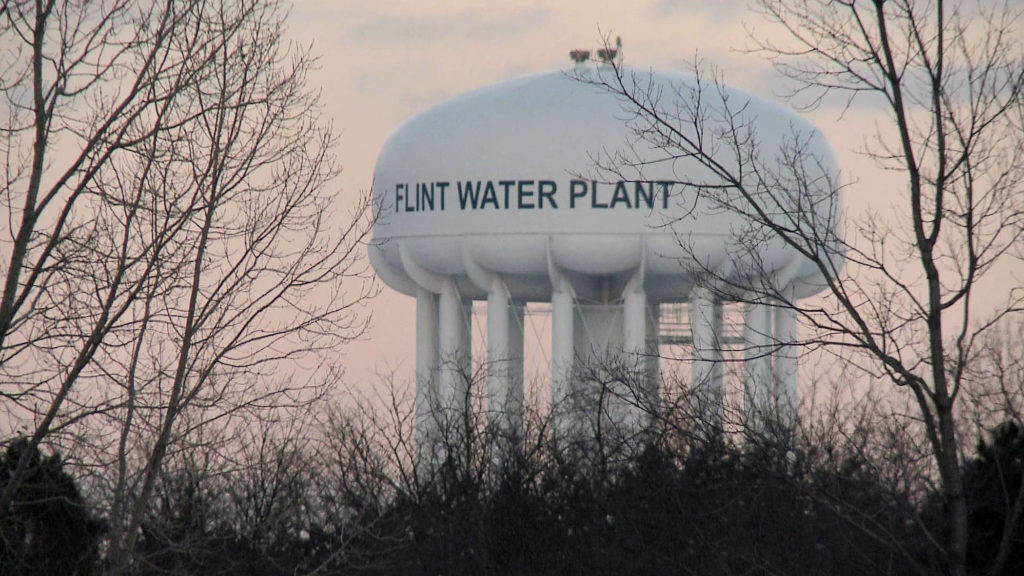
The Flint water tower – looking creepy. Photo Taken from Creative Commons.
All words leave remainders, as semioticians remind us,46 and indeed the poetry and power of words as metaphors are important in struggle. And Hannah Arendt cautions that “the protean elements of fascism always run the risk of crystalizing into new forms.” [47]
Sheldon Wolin was among the first theorists in recent times to offer a name as well as a penetrating description of our era in his 2008 classic Democracy Incorporated: Managed Democracy and the Specter of Inverted Totalitarianism. [48] Far from being exhausted by its 20th century versions, “would be totalitarians now have available technologies of control, intimidation and mass manipulation far surpassing those of that earlier time,” Wolin says. Unlike classic totalitarianism with its strong central control and rigid citizen mobilization, our times represent the political coming of age of corporate power and the political demobilization of the citizenry. With the constant downsizing, privatization, and outsourcing and the dismantling of the welfare state, the resulting state of insecurity makes the public feel so helpless that it is less likely to become politically active, he explains.
Flint was such a “managed democracy,” and the emergency manager performed the job of “manager of democracy.” The crisis title was a capable veneer to publicly present Michigan government with official, neutral-sounding authority to overrule democratic processes and exclude citizens from decision-making power that would have prevented a catastrophe. It offered legitimation for the collapse of local democracy. It was a device that attempted to render the population passive and impotent. It was built on a foundation of primitive accumulation and structural racism, enabling government to amass even more power.
In 2018, social theorist Henry Giroux distinguished our present time as a new era of neoliberal fascism, or extreme authoritarian capitalism. Giroux agrees with much of Wolin’s analysis but notes that Wolin, now deceased, had not witnessed the crushing developments of the past 10 years: the war on youth, the expansive level of disposability, the power of the new media and the rise of neo-fascism. He points out that Wolin “had nothing to say about the growing culture of cruelty, the rise of white supremacy, and the extreme mobilization of the conditions that make fascism tolerable again.” [49]
Critical Pedagogy against Civic Illiteracy
In my anthropology classes, I often see students with Ice Mountain water bottles. I ask them, “Where do you think your bottled water comes from?” They do not know and are shocked to find out. I discovered the same kind of civic illiteracy in 2002 when I was teaching anthropology in Flint as an adjunct professor for the University of Michigan-Flint. I discussed the culture of capitalism, students’ jobs and their everyday lives, inquiring how students thought Flint affected their health and personalities. Students knew next to nothing about the history of their city. When I asked their views of Roger and Me, by then well-established as a groundbreaking documentary, I was shocked to receive mostly blank stares.
The best picture of my students with Ice Mountain water bottles. Photo by Brian McKenna.
Dumbfounded, I asked the class of 52 how many had seen Moore’s 1989 film; only a few had. “Well, how many of you have even heard about it?” Again, most had not. I sought to help remedy this. So I placed an order for a 16-millimeter reelto- reel projector (it was pre-digital times) the following week and showed it to the class. They loved the film, hollering and hooting at people they actually knew. “There’s my aunt.” “Look at that guy, I know him!” As they drew connections between their plights and historical currents, one student asked, “Why hasn’t anybody showed us this before?”
These students lived inside history but were not aware of their place in it. So do we all, to one degree or another. This immobilizes us. Without understanding how we are saturated by capitalism in our everyday lives, we cannot properly identify the most effective tools to combat it, let alone expand our imaginations to end it. As C. Wright Mills wrote in The Politics of Truth, “The city is a structure composed of milieu; the peoples in the milieu tend to be rather detached from one another … they do not understand the structure of their society.”[50] It is the task of educators, journalists, activists and artists to teach students the hidden structures of their cities and to link that knowledge to the worldwide crisis of capital.
Consider the history of capital’s relationship with Flint. There is the story of primitive accumulation, taking of the commons by law, war and taxation. In Michigan history, the Anishinabek — who had thrived for more than 7,000 years — were cast onto reserves, surrounded by hostile neighbors and “subject to intense indoctrination.” Anthropologist Charles Cleland called this process “ethnocide.”[51] Flint and Detroit are two of the most racially segregated cities in the country, with ethnic enclaves that mimic the
isolated Indian reserves of the 19th-century Anishinabek.
In the 1930s, the famous sit-down strike against GM augured the birth of the United Auto Workers, a proud moment of advance. In the 1980s through the 2000s, GM struck back, pulling up to 80,000 jobs and sending them to cheap labor havens (citizens had no democratic vote on that topic). In this case, General Motors treated Flint like a “tap and sink,” tapping its river water (like a faucet) to build cars, despoiling its land, toxifying Flint’s air and sinking effluent into its soils and river as well into the bodies of its citizens, poisoning the town, then leaving.
In Flint, why did it take unpaid citizens, activist community groups, a Chicago-based EPA activist, a medical doctor and an “outside” professor from Virginia Tech to help expose some of the important hidden truths? Where were Michigan universities? Without fighting back, public universities are becoming knowledge factories for sale to the highest bidder. The constant fear of losing one’s job makes too many workers and professors engage in self-censorship, a humiliating experience. Activist citizens are branded by controlling interests as “troublemakers” and “outsiders,” isolated and derided, in fear of retaliation at their jobs. They learn — through praxis — that their jobs, schools and universities can resemble psychic prisons, ruled by managed bureaucracies of interlocking directorships who surveil deviance and manage noncompliance through blacklisting, bullying, mobbing and an audit culture of micromanagement. The local media are compliant, too, more interested in crime in the streets than crime in the suites.
Some journalists say the problem goes much deeper than the loss of newspapers, TV newsrooms and radio news. As Robert McChesney and John Nichols put it bluntly, “Every theory of popular government tells us democracy is unsustainable without an informed citizenry and journalism that monitors the powerful. Yet credible journalism is disappearing and the capacity to monitor is withering.”[52]
Conclusion
“The Fire in the Flint Never Shows Until it is Struck”
Old English Proverb
Flint is a good model to understand the life cycle of a company town: from boom to bust, toxic town to ghost town. It also illustrates multiple avenues of collective resistance. Flint is an excellent case to study with regard to David Harvey’s Seventeen Contradictions and the End of Capitalism. [53] Harvey details several processes by which capital proceeds with its incessant accumulation of the earth: devouring nature, crippling people and turning “the commons” into private commodities for capital’s gain.
A proper education involves active norm breaking, incessant questioning and acts of civil disobedience, when called for. It is civic engagement with attitude. As Paulo Freire taught, education is highly political: it is a struggle for meaning and a battle over power relationships.[54] The second phrase is the key one, for it requires a praxis of constructive troublemaking. The critical pedagogy school of education requires enacting our pedagogies, curricula and practices. Complacency is no longer an option for social scientists.
The Flint water crisis sparked rapper Bootleg(i.e., Ira Dorsey) to write a song, “The City of Lead” [55] (Bootleg of the Dayton Family 2017), where he angrily takes on Governor Snyder for all the hatred, poverty and racism that exist in his hometown. [56] No one has been prosecuted, including the governor, for poisoning his family and friends, Dorsey says. “If I poisoned one person, I’d be in jail.” [57] The song contains a fusillade of lyrics, but one line caught my attention: “We got lead in the water; we got lead in our guns.” Like a flintlock. For all of Michigan’s efforts to contain and control Flint’s citizenry, the spirit of resistance has never completely faltered. The full story is yet to be told. The fight is never over.
Notes
1. Michelle Wolf, “White House Correspondents Dinner,” C-SPAN, April 28, 2018, https://
www.youtube.com/watch?v=DDbx1uArVOM.
2. Henry Giroux, interview, June 17, 2018.
3. Dena Takruri, “Why Flint Still Doesn’t Have Clean Water after Four Years?” Qatar: Al
Jazeera, 2018, https://www.youtube.com/watch?v=9iCdkjW4YQ8.
4. Takruri, “Why Flint Still Doesn’t have Clean Water after Four Years?”
5. Curt Guyette, “Flint and Unexpected Consequences,” Detroit Metro Times: ACLU of Michigan,
April 18, 2018.
6. Takruri, “Why Flint Still Doesn’t have Clean Water after Four Years?” Brian McKenna The Specter of Neoliberal Fascism 57
7. Wolf, White House Correspondents Dinner.
8. Kathleen Gray, “Michigan OKs Nestle Permit for Increased Water Withdrawal for Bottled Water Plant,” Detroit Free Press, April 2, 2018.
9. Amy Goodman, “Michigan’s Water Wars: Nestlé Pumps Millions of Gallons for Free While
Flint Pays for Poisoned Water,” Democracy Now, February 17, 2016, https://www.democracynow.org/2016/2/17/michigans_water_wars_nestle_pumps_millions.
10. Olson, Jim, “Why Michigan Citizens for Water Conservation’s Contested Case Against the Nestlé Water Permit Is Right and Necessary,” FLOW Blog, June 8, 2018, http://flowforwater.org/michigan-citizens-water-conservations-contestedcase-nestle-water-permit-right-necessary.
11. Keith Matheny and Paul Egan, “Nestle Bottled Water Company Seeks to Take More Michigan
Water,” Detroit Free Press, November 22, 2016.
12. Brian McKenna, “Great Lakes for Sale: Michigan’s Odawa Indians Lead Anti-Nestle Fight,” Free Press. April 22, 2006, http://www.freepress.org/departments/display/3/2006/1935.
13. Will Bunch, “Michelle Wolf’s Truth Bombs Aren’t the Only Thing America’s Elite Journalists
Don’t Get,” Philadelphia Inquirer, April 30, 2018.
14. Steve Carmody, “Flint’s Mayor Exploring ‘Legal Options’ after Meeting with Governor,” Michigan Public Radio, April 16, 2018.
15. Steve Carmody, “Officials Charged in Flint’s Water Crisis Back in Court This Week, 2 Years after First Indictments,” Michigan Public Radio, February 6, 2018.
16. “The Curse of Totalitarianism and the Challenge of Critical Pedagogy,” By Henry Giroux,
Truthout, October 2, 2015.
17. Henry Giroux , “Manufactured Illiteracy and Miseducation: A Long Process of Decline Led
to President Trump,” Salon, June 24, 2017.
18. Todd Spangler, “Del Toral: EPA Didn’t Make Flint Children a Priority,” Detroit Free Press,
March 15, 2016.
19. Donovan Hohn, “Flint’s Water Crisis and the ‘Troublemaker’ Scientist,” New York Times
Magazine, August 16, 2016.
20. Curt Guyette, “Why Strict Federal Oversight is Needed to Safeguard Flint’s Water,” Detroit
Metro Times: ACLU of Michigan, October 5, 2015.
21. Monica Erb, “Flint Doctor Makes Flint See Light in Lead about Water,” Detroit Free Press, October 10, 2015.
22. Paul Egan, “Lawsuit: Flint’s water Crisis Hit Jail Inmates Especially Hard,” Detroit Free Press, June 26, 2018.
23. Virginia Tech, “Commencement Address: Flint Researchers Professor Marc Edwards and Dr.
Mona Hanna-Attisha Address the Class of 2016,” Virginia Tech, May 13, 2016, https://www.you
tube.com/watch?v=kxL-F1lOuOc.
24. Virginia Tech, “Commencement Address.”
25. Virginia Tech, “Commencement Address.”
26. Public Employees for Environmental Responsibility, “The Story of Water Resources at Work, Ingham County, Michigan,” PEER (Washington, D.C.), September 19, 2001, news release http://www.peer.org/news/news_id.php?row_id=100.
27. Brian McKenna, “Education for What? A Chronicle of Environmental Health Deception in
Lansing, Michigan,” Cooley Law Review 20, no. 2 (2003), 1–54; Jeff Ruch, interview, April 2, 2018.
28. Jeff Ruch, interview , April 2, 2018.
29. Donovan Hohn, “Flint’s Water Crisis and the ‘Troublemaker’ Scientist,” The New York Times
Magazine, August 16, 2016.
30. Yanna Lambrinidou, interview, May 13, 2018.
31. Lambrinidou, interview.
32. Lambrinidou, interview.
33. Yanna Lambrinidou, “Paradigm of Resident & Expert Power” (presentation, Untrouble the Waters Conference, Chicago, IL, May 10, 2017), https://www.youtube.com/watch?v=ftacXjCaNNA.
34. Larry Gabriel, “Flint Whistleblowers Who Exposed Their Poisoned Water: We’re Just Getting
Started,” Yes Magazine, February 2, 2016.
35. E. B. Allen, “Ex-Offenders Play Key Role in University’s Research,” The HUB Flint, October
17, 2017.
36. Derrick Z. Jackson, “Environmental Justice? Unjust Coverage of the Flint Water Crisis,” Harvard Kennedy School/Shorenstein Center on Media, Politics and Public Policy, July 11, 2017,
https://shorensteincenter.org/environmental-justice-unjust-coverage-of-the-flint-water-crisis/.
37. Jackson, “Environmental Justice?”
38. Jackson, “Environmental Justice?”
39. Jackson, “Environmental Justice?”
40. Peter J. Hammer, “The Flint Water Crisis, the Karegnondi Water Authority and Strategic-
Structural Racism,” Critical Sociology, October 16, 2017, https://journals.sagepub.com/doi/
abs/10.1177/0896920517729193.
41. Hammer, “The Flint Water Crisis.”
42. Hammer, “The Flint Water Crisis.”
43. Emily Green, “Detroit’s ‘the Canary in the Mine’ for Portland, Says Water Quality Activist,”
StreetRootsNews (Portland, OR), April 27, 2018.
44. Sheldon Wolin, Democracy Inc., Managed Democracy and the Specter of Inverted
Totalitarianism (Princeton: Princeton University Press, 2008).
45. Henry Giroux, American Nightmare, Facing the Challenge of Fascism (San Francisco: City
Lights, 2018)
46. Theodor Adorno, Negative Dialectics (New York: Continuum, 1981 [1951]).
47. Giroux, American Nightmare.
48. Wolin, Democracy Inc.
49. Henry Giroux, interview, June 17, 2018.
50. C. Wright Mills, The Politics of Truth, Selected Writings of C. Wright Mills (Oxford: Oxford
University Press, 2008).
51. Charles Cleland, Rites of Conquest: The History and Culture of Michigan’s Native Americans
(Ann Arbor: University of Michigan Press, 1992).
52. Robert McChesney and John Nichols, The Death and Life of American Journalism (Philadelphia: Perseus, 2010).
53. David Harvey, Seventeen Contradictionsand the End of Capitalism (Oxford: Oxford University Press, 2015).
54. Paulo Freire, Pedagogy of the Oppressed (New York: Continuum, 2000 [1968]).
55. Bootleg of the Dayton Family, City of Lead, 2017, https://www.youtube.com/watch?v=qtfv2mF8pEo.
56. Takruri, “Why Flint Still Doesn’t have Clean Water after Four Years?”
57. Takruri, “Why Flint Still Doesn’t have Clean Water after Four Years?” Brian McKenna is a medical/environmental anthropologist and journalist with three decades of experience as a public anthropologist. In the 1980s, he worked in Philadelphia as a health policy analyst for a number of nonprofits, including Temple University’s Institute for Public Policy Studies and the United Way’s Community Services Planning Council, and later as developmental specialist
for NPR’s Fresh Air. He worked for six years in medical education (1992–98) as an evaluator
for the W.K. Kellogg Foundation to create community-oriented primary care practitioners, the topic of his dissertation. He has written for more than a dozen journalistic outlets, including a weekly environmental health column for Lansing’s City Pulse. In 2002, Brian received an environmental achievement award from Michigan’s Ecology Center for his governmental and journalistic work. Brian is currently working on a book manuscript, “Reinventing Anthropology in the End Times.” He teaches at the University of Michigan-Dearborn.
One Response
You think 5 years is bad….
Clean Drinking Water Comes To West Virginia Town After 17-Year Hiatus.
In 2010, the racial makeup of the McDowell County was 89.1% white, 9.5% black or African American, 0.2% American Indian, 0.1% Asian, 0.0% from other races, and 1.1% from two or more races.
In 2010, the racial makeup of the McDowell County was 89.1% white, 9.5% black or African American, 0.2% American Indian, 0.1% Asian, 0.0% from other races, and 1.1% from two or more races.




One Response
You think 5 years is bad….
Clean Drinking Water Comes To West Virginia Town After 17-Year Hiatus.
https://www.wbur.org/hereandnow/2019/08/19/clean-drinking-water-west-virginia
Where was the media coverage?
In 2010, the racial makeup of the McDowell County was 89.1% white, 9.5% black or African American, 0.2% American Indian, 0.1% Asian, 0.0% from other races, and 1.1% from two or more races.